Mineralogical characteristics
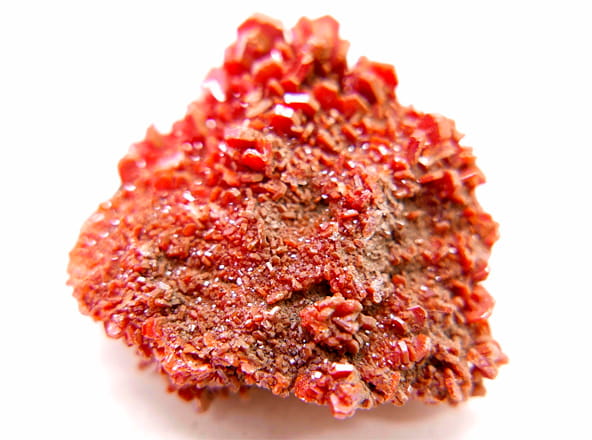
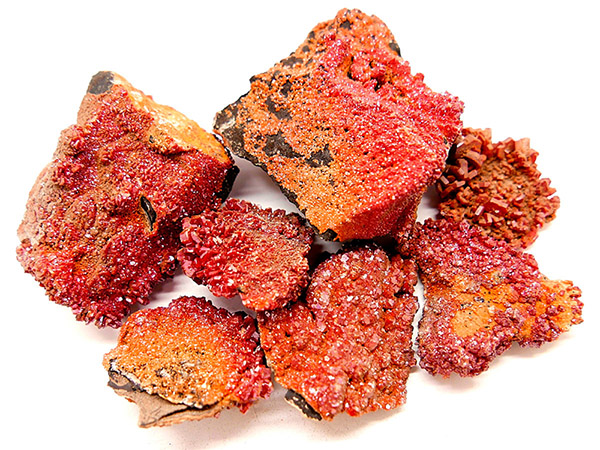
Vanadinite is a lead chlorovanadate belonging to the apatite group. It is characterized by its intense orange-red crystals, although it may also occur in yellow, brown or reddish tones.
It usually forms prismatic and tabular crystals of hexagonal symmetry, often with well-defined faces and adamantine luster. In some specimens, it may appear in acicular or hairy forms, while compact masses are uncommon.
Vanadinite forms as a secondary mineral in oxidation zones of lead deposits. It usually appears associated with other minerals such as limonite, galena or barite.
Because of its color, high density and geometric crystallization, it is a highly appreciated species in mineral collecting. Its most striking specimens are usually preserved as collector’s pieces rather than used in jewelry, due to their fragility and lead content.
Deposits
United States.
Therapeutic properties
Vanadinite is traditionally associated with the base chakra and is considered a stone of connection with the earth. It is used in energetic therapies to encourage grounding, stability and concentration.
It is said to help calm excessive mental thought, facilitating more focused and serene meditative states. It is also related to the ability to define objectives, organize priorities and maintain the consistency needed to carry them out.
On an energetic level, vanadinite is considered a stimulating stone, linked to the flow of body energy and vitality.
It has traditionally been associated with the respiratory system, although these attributions belong to the field of energetic therapy and do not replace professional medical diagnosis or treatment.