Mineralogical characteristics
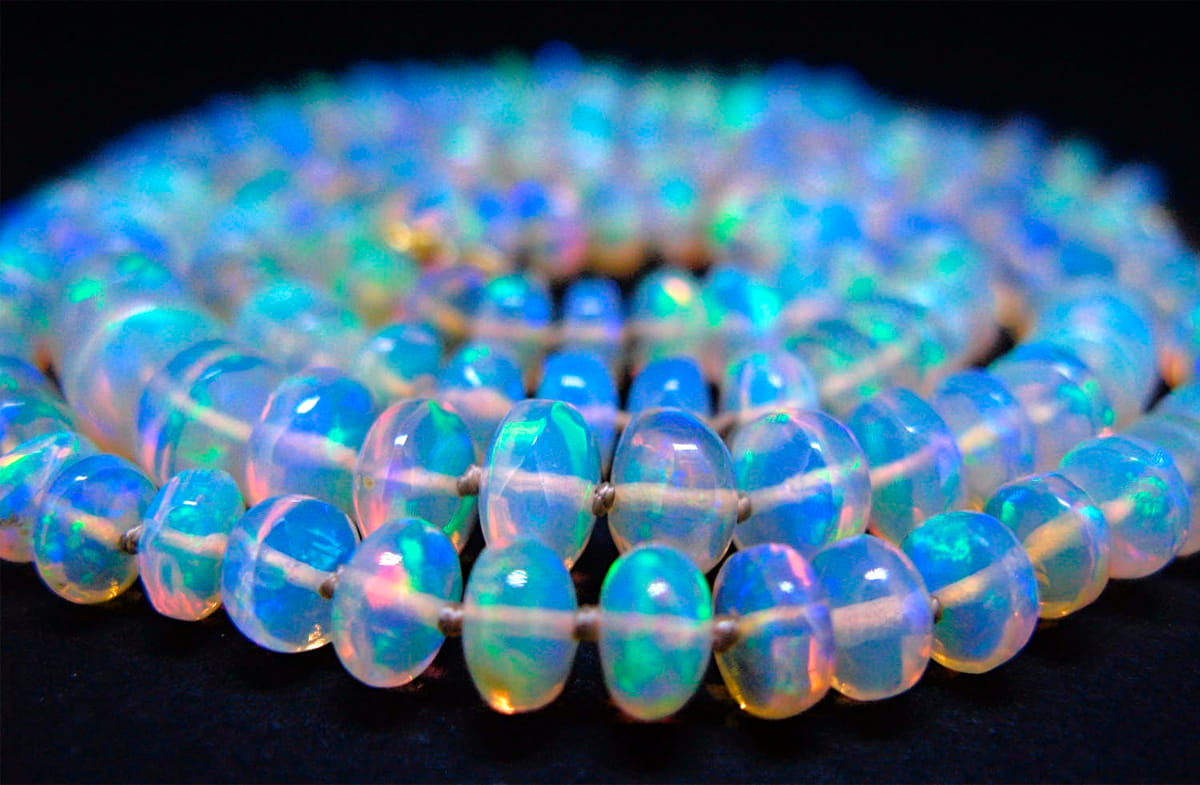
Opal is a unique mineraloid within the mineral world, as it does not have a defined crystalline structure. It is formed from a hardened silica gel containing between 5% and 10% water. This composition gives it an amorphous and compact structure, considered one of its main singularities. Among the physical properties of opal, its ability to reflect light stands out, generating iridescent flashes thanks to the internal arrangement of its microscopic particles.
This optical phenomenon is especially visible in precious opal, the most valued variety, where the colors seem to move inside it as the angle of light changes. For this reason, opal is widely used in opal jewelry, standing out for its beauty and dynamic appearance.
There are multiple varieties of opal, which may display white, black, bluish, green, yellow, brown or reddish tones, as in the case of fire opal. These color variations are due to the presence of different elements such as iron, manganese or organic carbon during its formation.
Opal is found in cavities of volcanic rocks, in hydrothermal deposits and in sedimentary accumulations. It can also appear as fossilized wood, preserving ancient organic structures. Its main deposits are located in Australia, Ethiopia, Mexico, United States, Peru, Canada and Slovakia.
Its delicate appearance, water content and play of color make opal a stone especially valued both in ornamental and energetic fields.
Deposits
Australia, Ethiopia, Mexico, United States, Peru, Canada and Slovakia.
Therapeutic properties
The properties of opal make it a mineral of great energetic intensity, associated with emotional awakening and the expansion of consciousness. Its vibration is linked to vital energy, stimulating creativity, spontaneity and connection with the deepest emotions.
Opal acts as an amplifier of internal states, enhancing both joy and sensitivity. For this reason, it is considered a stone that helps release inhibitions and express personal authenticity. It is also related to self-esteem, supporting confidence and motivation to advance in personal projects.
On the energetic plane, the opal chakra may vary depending on its color. For example, light or white opals are associated with spiritual connection, while more intense ones may influence emotional balance. In general, it is a stone that helps harmonize the body’s energy flow.
On an emotional level, it encourages the release of blockages and the understanding of internal processes, being useful in moments of change or introspection. However, due to its intensity, it is recommended to use it consciously and not combine it with other minerals.
On the physical plane, benefits are attributed to it for psychosomatic ailments, helping to balance body and mind. Its active energy promotes well-being and personal renewal.