Mineralogical characteristics
Obsidian stone, especially black obsidian, is the most common form of this natural material. It is a volcanic glass or natural glass that forms when silica-rich lava cools extremely quickly. This process prevents mineral crystallization, so obsidian is not considered a mineral in the strict sense, but an amorphous igneous rock.
The origin of obsidian is linked to volcanic eruptions, where magma flows and solidifies on the Earth’s surface in a matter of seconds. Due to this sudden cooling, it presents a conchoidal fracture, allowing very sharp edges to be obtained. This property made common obsidian widely used in ancient times to make tools, weapons and cutting utensils.
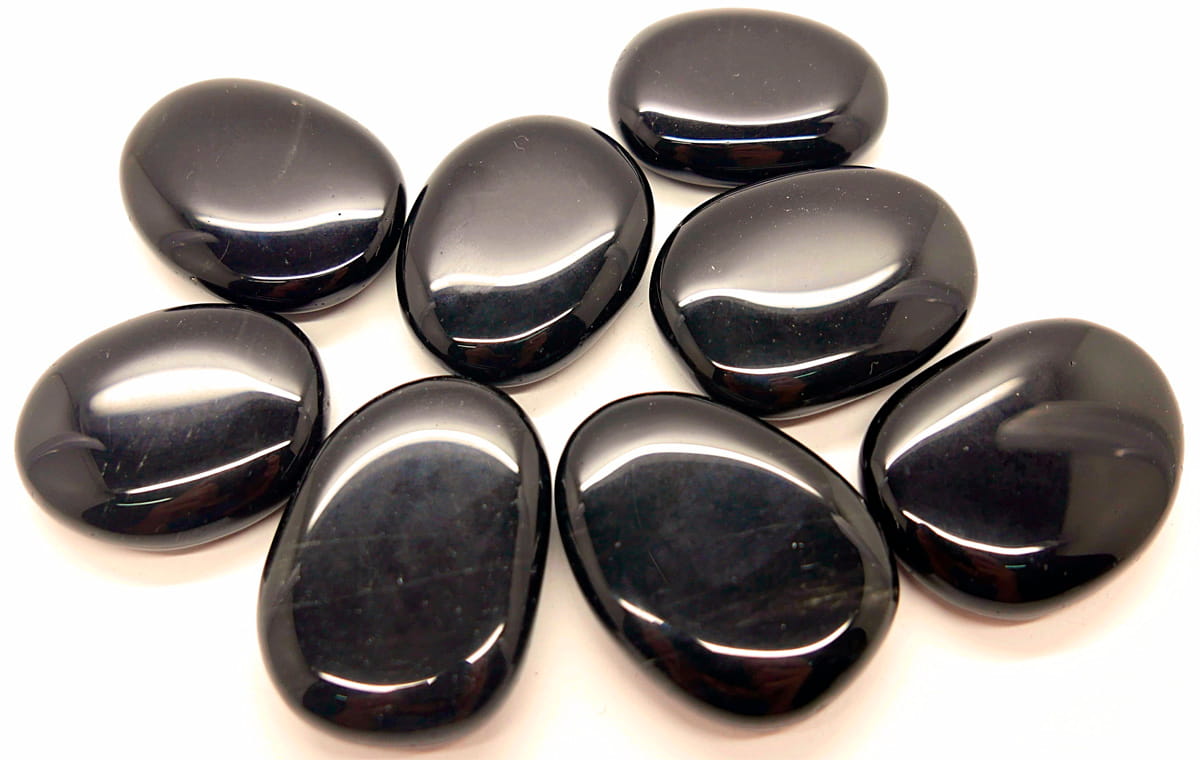
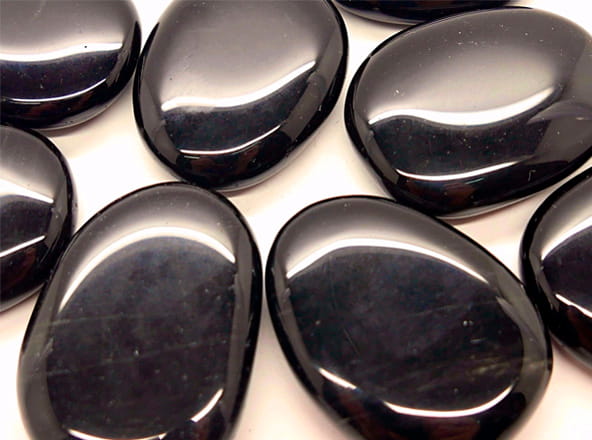
Its predominant color is intense black, although it may show variations depending on mineral inclusions. In addition, its vitreous surface can reflect light differently depending on the angle, creating visual effects known as dichroism.
The name “obsidian” comes from the Latin lapis obsianus, in reference to Obsius, a Roman who, according to Pliny, discovered this material. Throughout history, it has been used by cultures such as the Mesoamerican peoples to create polished mirrors, amulets and ritual objects.
Today, black obsidian is used in jewelry, ornamentation and very specific medical applications, such as high-precision scalpels. Its main deposits are found in Mexico, United States, Peru, Chile, Iceland, Italy, Japan and Turkey.
The name obsidian comes from the Latin "lapis obsianus", "obsidian stone", a name derived from Obsius, a Roman man, supposedly a well-known explorer or naturalist, mentioned by Pliny (1st century AD).
In ancient times, obsidian was highly valued because of its conchoidal fracture, which allows very sharp points and cutting tools to be made. It was also used as an amulet and as ornamentation. Mesoamerican cultures polished obsidian to make mirrors, as it has a vitreous and reflective luster. Today obsidian is used in jewelry making and ornamentation and in the manufacture of surgical cutting blades.
Deposits
Mexico, Argentina, Peru, United States, Australia, Chile, Guatemala, Iceland, Greece, Kenya, Italy, Turkey, Japan and Hungary.
Therapeutic properties
The properties of black obsidian make it one of the most intense stones in energetic work. It is considered a key tool for personal growth, as it acts as a mirror that reflects both inner light and shadow. This quality allows one to become aware of hidden patterns and move toward greater personal understanding.
Black obsidian is also a powerful protection stone. Within the group of black stones, it is used to absorb dense energies and support energetic cleansing. It helps release emotional blockages and face deep fears, facilitating processes of inner transformation.
On a psychological level, it enhances introspection and mental clarity. It may bring accumulated memories, emotions or tensions to the surface that need to be worked through. For this reason, conscious use is recommended and, in some cases, accompaniment by a professional in energetic therapies.
It also brings strength and stability, helping one remain firm in complex situations. Its energy is direct and deep, making it a suitable stone for those who wish to advance in their inner development.
Overall, obsidian acts as a tool of self-knowledge that drives personal evolution and the integration of experiences.
Symbolically, obsidian represents the "mirror" in which the totality of the self is reflected, with its shadow and its strength. One of its characteristic properties is to directly show limiting and dark aspects of oneself, giving the opportunity to heal, release, transmute or integrate them. It can bring weaknesses, blockages, traumas and memories to the surface. It is advisable to use it with the accompaniment of a qualified therapist.