Mineralogical characteristics
Moldavite is a unique meteorite stone, recognized for its olive-green color and its origin associated with ancient meteorite impacts. It is a glassy mineral belonging to the tektite group, materials formed when a large meteorite impacts the Earth’s surface, melting sediments and projecting them into the atmosphere. As they cool in flight, these fragments become natural glass. This group includes tektites found on almost all continents, except Antarctica and South America.
The origin of moldavite dates back to an impact that occurred approximately 15 million years ago in the region of present-day Germany. As a result, large quantities of molten material were expelled toward what we now know as Bohemia, in the Czech Republic, where they crystallized in the form of moldavites. One of the characteristics that differentiates it from other tektites is its specific chemical composition and its low water content, which makes it especially valuable.
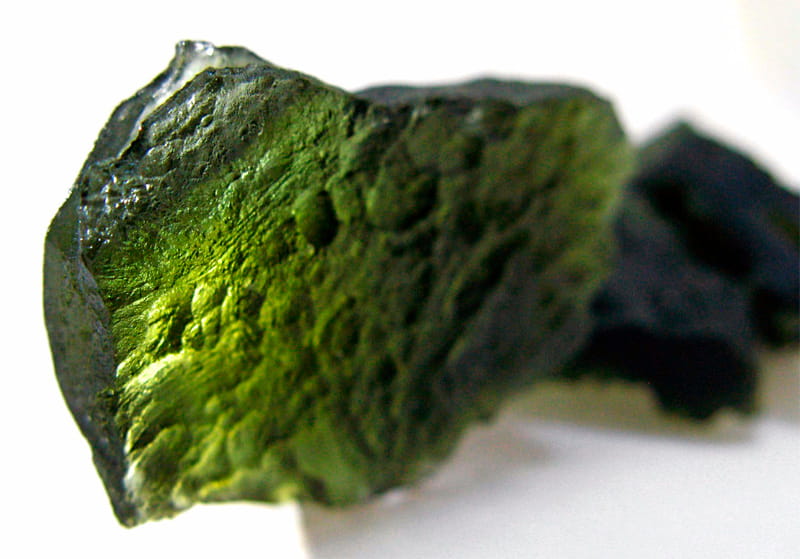
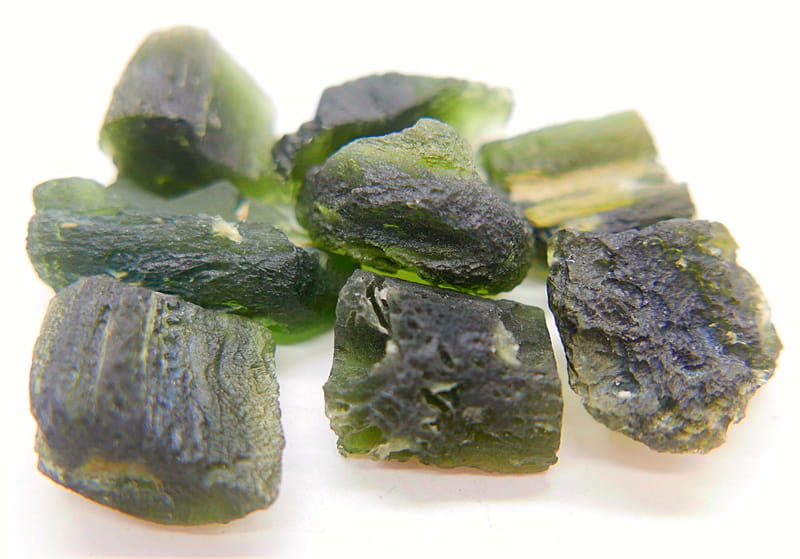
The surface of moldavite is usually very distinctive: it has indentations, reliefs and natural patterns reminiscent of forms sculpted by wind or water. Raw moldavites show irregular textures and a translucent shine that varies according to the angle of light. This highly characteristic appearance fed ancient beliefs and gave rise to popular names such as Bouteillen-stein or “bottle stone”.
The term “moldavite” was first used in 1836 and refers to the Vltava River, the area where the best-known specimens were found. Although the most accepted theory states that moldavite formed from a terrestrial impact, some researchers —such as NASA scientist Dean R. Chapman— proposed the possibility of a lunar origin, based on similarities between certain volcanic structures on the Moon and those present in some fragments.
The main deposits of this stone are found in the Czech Republic, Germany and Austria, with minor finds in Moldova. Its scarcity contributes to its value and its popularity among collectors and mineral lovers.
When the tektite has an olive-green color, it is the highly valued moldavite, considered special because of its low water content, difficult fusibility and chemical composition.
The word moldavite was first used in 1836, a term derived from the town of Moldauthein, in Bohemia (Czech Republic), where scientists first presented it in 1786. It was also commonly called “Bouteillen-stein”, "bottle stone", because of its similarity.
There is controversy over the origin of moldavite; most theories point to the fusion of materials in a terrestrial meteorite impact, which would be the most popular theory. A second viable theory should also be noted, attributing a lunar origin to it, after lunar volcanic structures were found in some analyzed pieces, a theory developed by NASA scientist Dean R. Chapman, among others.
Most moldavites were found in the valley of the Vltava River, in southern Bohemia (Czech Republic). Smaller quantities were also found in the Moravia region and, recently, a few in Austria.
Deposits
Czech Republic, Germany, Moldova and Austria.
Therapeutic properties
Moldavite stone is known for its intense vibration and for being a catalyst of personal transformation. It is said that its energy, derived from the ancient rocky meteorites that gave rise to the mineral, supports spiritual growth and awakens inner perception. Many people use it during meditation because it helps open intuitive vision and connect with subtler planes of consciousness. Placed on the third eye, it enhances mental clarity and the ability to receive symbolic or intuitive information.
One of the most valued characteristics of moldavite is its ability to mobilize and release negative energies, creating a lighter vibrational field oriented toward positive change. It is considered a suitable stone for those going through processes of personal renewal or wishing to let go of old patterns.
It is also said to support chakra alignment and deep energetic cleansing. Its expansive energy drives inner transformation and helps perceive one’s personal path more clearly. In addition, moldavite can inspire creativity and support the manifestation of new ideas. For all these reasons, this stone is used as a tool to move forward, raise vibration and strengthen connection with the Earth and the universe.