Mineralogical characteristics
Malachite is a mineral highly valued both for its beauty and for its historical relevance. When asking what malachite is, it can be defined as a hydrated copper carbonate whose chemical formula is Cu₂CO₃(OH)₂. It forms as a secondary copper ore and appears in environments where this metal alters and combines with other elements present in the ground.
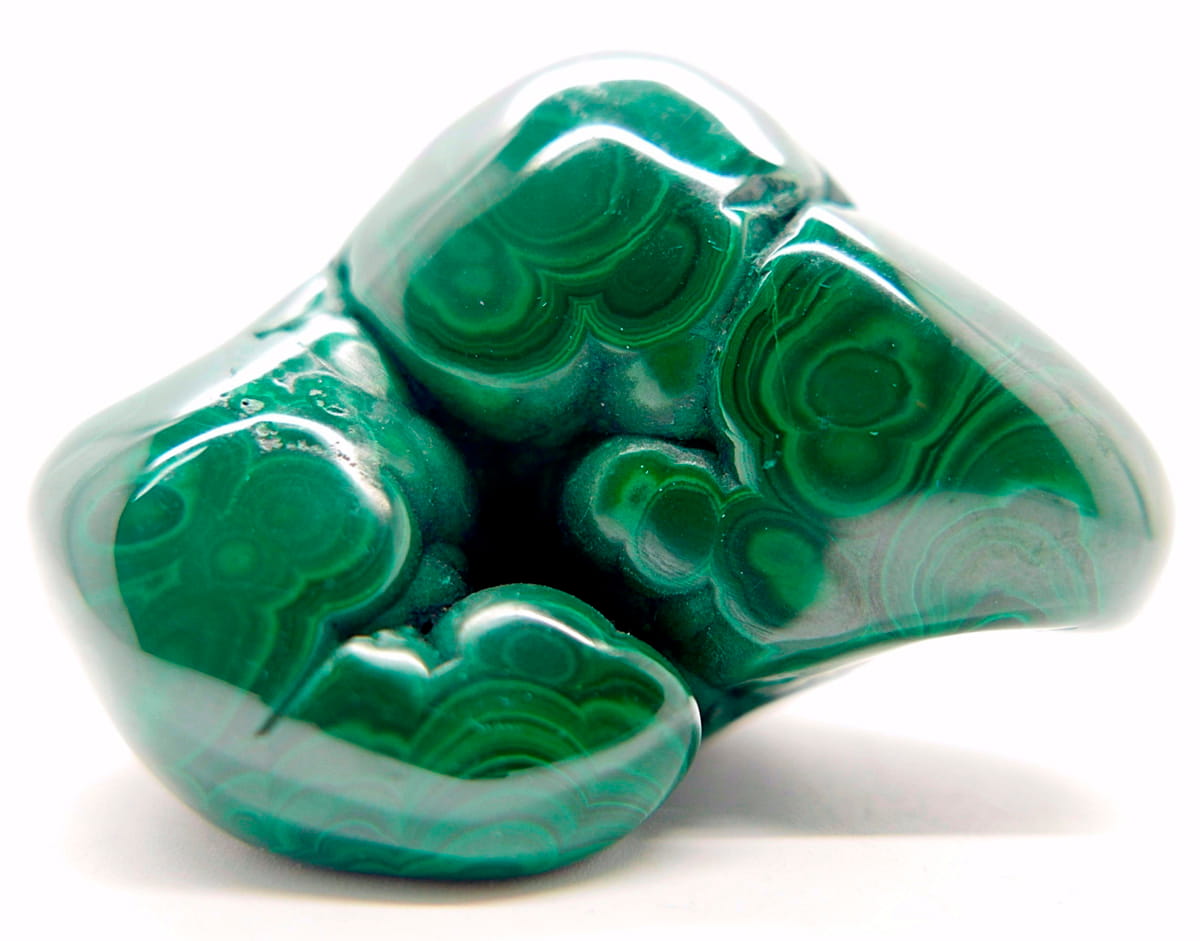
Its structure usually appears in botryoidal masses, reniform aggregates or fibrous forms that generate highly striking natural patterns. Occasionally, it is also found as stalactites with concentric bands or even as prismatic crystals, although these are uncommon. The main visual characteristic of malachite is its green bands, which can range from light tones to deep, dark greens. These veins are especially visible when the mineral is cut or polished, which is why it is often worked as a cabochon for jewelry.
The origin of malachite is closely linked to the history of humanity. It is considered one of the first minerals that enabled the development of metallurgy. Around 4000 BC, it was discovered that heating malachite produced native copper, a fact that marked a turning point in technological, craft and social evolution.
Its importance was not limited to practical use: in ancient Egypt, malachite was used as a pigment for murals, as eye cosmetic and as a protective amulet. Later, in the Middle Ages, authors such as Saint Hildegard of Bingen mentioned the benefits of malachite in natural medicine.
Today, the main malachite deposits are found in Congo, Russia, Zambia, Namibia, Morocco, Colombia, Australia, China, United States, Romania, South Africa and France. These deposits produce specimens known for their green patterns and their great decorative and spiritual value. The meaning of malachite remains associated with transformation, protection and energetic renewal.
The main characteristic of malachite is its bands in various shades of green, which can be appreciated through cutting or polishing, making it a mineral often cut as a cabochon for jewelry making.
Malachite could be considered one of the most important minerals in human history, as it directly contributed to the development of metallurgy, specialized skills and organized work, after it was discovered that it transformed into native copper when melted with fire (4000 BC).
In ancient Egypt, malachite was used as eye cosmetic, as pigment in murals and glass, and as an amulet. We also find ancient sources that speak of the medicinal properties of malachite, such as the work “Psyca” by Saint Hildegard of Bingen (12th century).
Deposits
Congo, Russia, Colombia, Hungary, Morocco, United States, Zambia, Romania, South Africa, Zimbabwe, Namibia, China, Australia and France.
Therapeutic properties
Malachite is known as a stone of transformation, capable of moving and releasing stagnant energies. Its intense energy acts as a catalyst for processes of change, helping to go deeper into emotional blockages and move toward greater personal understanding. On an energetic level, it is deeply related to the heart chakra, the center that governs love, compassion and emotional balance. By working on this chakra, malachite allows one to open to healing and connect with more authentic feelings.
One of the most valued properties of malachite is its ability to absorb negative energies from the environment and transform them into a more harmonious vibration. For this reason, it is often used as a protective stone in sensitive spaces or in energetic practices. It combines very well with rose quartz and green quartz, creating a balanced set that enhances serenity and emotional well-being.
On a physical level, it is used to relieve discomfort by placing the stone directly on the affected area, as it is believed to help soothe pain and promote muscle relaxation. It is also used as protection against electromagnetic radiation. However, it should not be used for elixirs, as its composition —derived from copper carbonate— can be toxic if ingested.