Mineralogical characteristics
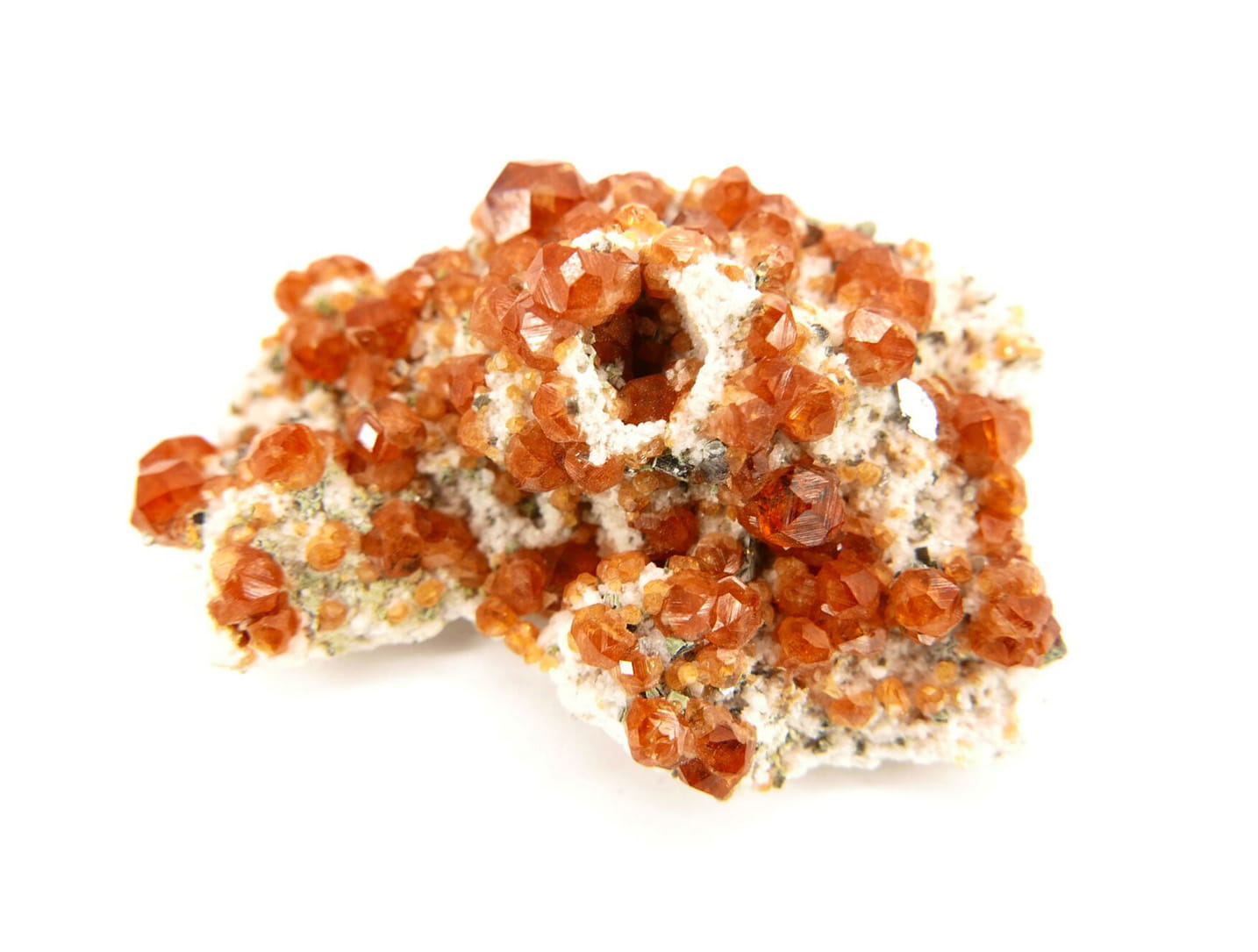
Grossular belongs to the garnet group, which are silicates that share a crystal structure, with the typical isometric form of 12 to 24 trapezoidal faces, and which appear implanted or semi-implanted in granular aggregates from compact to dense. They appear in crystals with imperfect cleavage, generally in metamorphic rocks.
Grossular is a calcium aluminum silicate that normally forms through contact metamorphism in limestone and siliceous sedimentary rocks. Its varieties may be green, colorless, yellowish, orange-brown or red.
It was named by Abraham Gottlob Werner, first as cinnamon stone and later renamed grossularite by him in 1808, due to its color and appearance similar to a gooseberry cluster, from the Latin "ribes grossularia".
Deposits
Canada, Mexico, Kenya, Italy and Sri Lanka.
Therapeutic properties
In addition to the properties of garnet, grossular brings fluidity and inspires service and cooperation. On a physical level, it is said to be beneficial in cases of arthritis and rheumatism, and to strengthen the kidneys, mucous membranes and skin.